
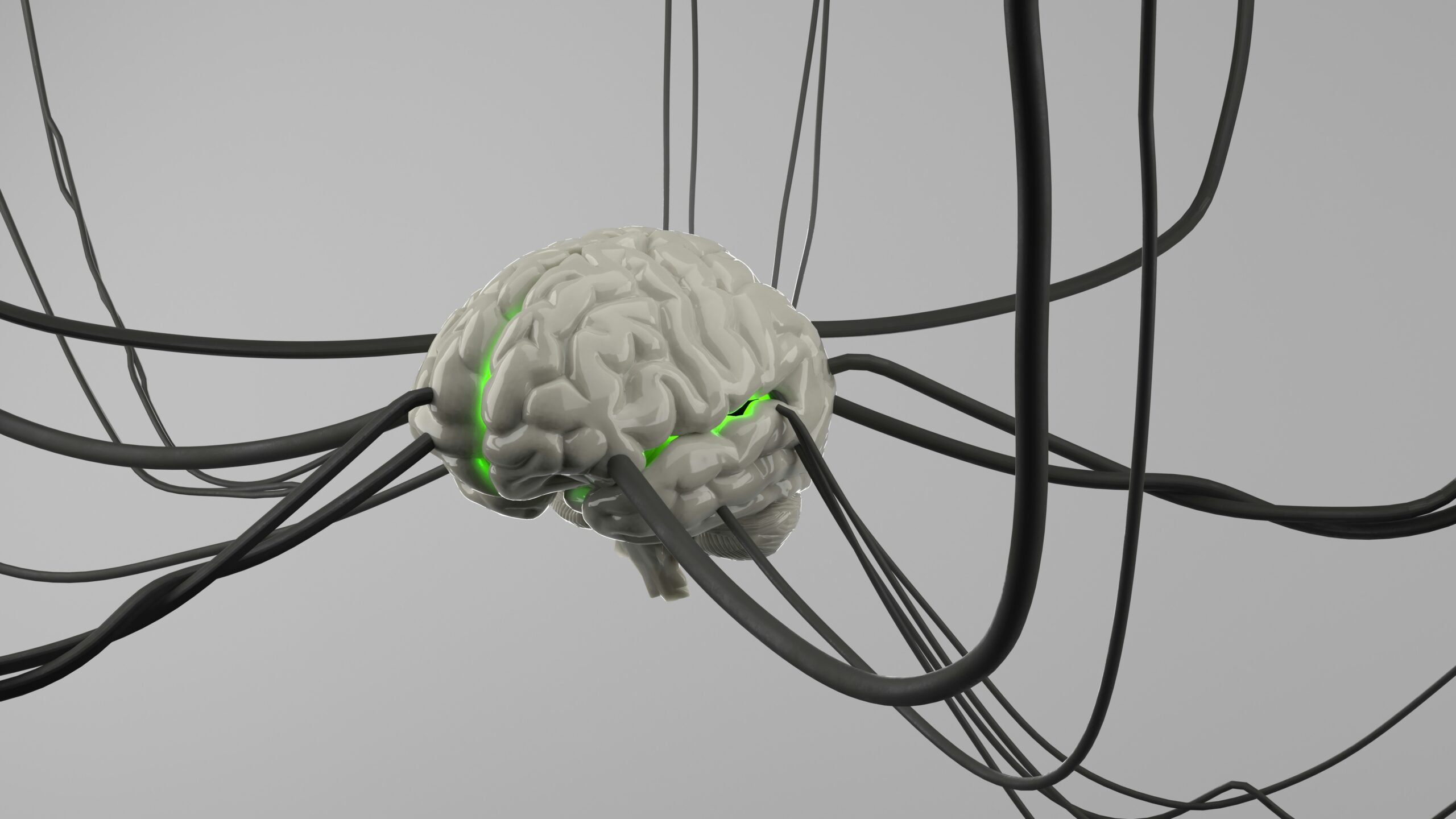
脳コンピュータインターフェース(BCI)は、脳の電気信号を計測・解読し、身体を動かさずにコンピュータや外部機器を操作する医工学技術です。脳の信号で意思を伝えたり、逆に外部からの刺激を脳に送ったりする技術であり、ALS(筋萎縮性側索硬化症)などの患者のQOL向上や医療リハビリ、将来的な能力拡張への応用が期待されています。
技術の仕組みと分類
BCIは、主に以下の2つの方式に分類されます。
- 侵襲型(しんしゅうがた): 手術で脳の内部に電極を埋め込む手法。高精度で信号を取得できるが、身体への負担が大きい。
- 非侵襲型(ひしんしゅうがた): 頭皮に電極を装着して脳波(EEG)を計測する手法。負担は少ないが、信号の精度は侵襲型に劣る。
主な目的と応用分野
- 医療・介護分野: 意思疎通支援(発語困難な人の文字入力)、車椅子操作、義手・義足の制御。
- リハビリテーション: 脳卒中後の運動機能回復。
- メンタルヘルス: 脳波のリアルタイムフィードバックによる、うつ病やADHDなどの症状改善・自己訓練。
- 能力拡張: 脳の情報を直接コンピュータとやり取りすることで、記憶力や学習能力の向上を研究。
主な企業・プロジェクト
- Neuralink(ニューラリンク): イーロン・マスク氏が創設した、脳に電極を埋め込む侵襲型BCI開発の著名企業。
- ムーンショット型研究開発事業: 日本政府が主導する、2050年までに「思い通りに操作できるアバター(サイバネティック・アバター)」の実現を目指すプロジェクト。

Lateral Ventricular Brain-Computer Interface System with Lantern-Inspired Electrode for Stable Performance and Memory Decoding
We present a lateral ventricular brain-computer interface (LV-BCI) that deploys an expandable, flexible electrode into the lateral ventricle through a minimally invasive external ventricular drainage pathway. Inspired by the framework of traditional Chinese lanterns, the electrode expands uniformly within the ventricle and conforms to the ependymal wall. Compared with conventional subdural ECoG electrodes, the LV-BCI shows superior signal stability and immunocompatibility. Resting-state spectral analyses revealed a maximum effective bandwidth comparable to subdural ECoG. In evoked potential tests, the LV-BCI maintained a consistently higher signal-to-noise ratio over 112 days without the decline typically associated with scarring or other immune responses. Immunohistochemistry showed only a transient, early microglial activation after implantation, returning to control levels and remaining stable through 168 days. We further designed an “action-memory T-maze” task and developed a microstate sequence classifier (MSSC) to predict rats’ turn decisions. The LV-BCI achieved prediction accuracy up to 98%, significantly outperforming subdural ECoG, indicating enhanced access to decision-related information from deep structures such as the hippocampus. These results establish the lateral ventricle as a viable route for neural signal acquisition. Using a lantern-inspired flexible electrode, we achieve long-term stable recordings and robust memory decision decoding from within the ventricular system, opening new directions for BCI technology and systems neuroscience.
AI技術の進化により、脳信号の解読精度が急速に向上している一方、脳への刺激によって感覚をフィードバックする研究も進んでいます。